Agile Development, Agents, and ThoughtWorks
Looking back through agile practice, agent collaboration, and the training style of ThoughtWorks, the capabilities software teams really depend on are alignment, decomposition, expression, and modeling.
Breaks Agent development into modular design, outcome‑driven delivery, and continuous evolution, mapping each to concrete components and practices.
Technical and engineering practice notes organized in reverse chronological order.
Looking back through agile practice, agent collaboration, and the training style of ThoughtWorks, the capabilities software teams really depend on are alignment, decomposition, expression, and modeling.
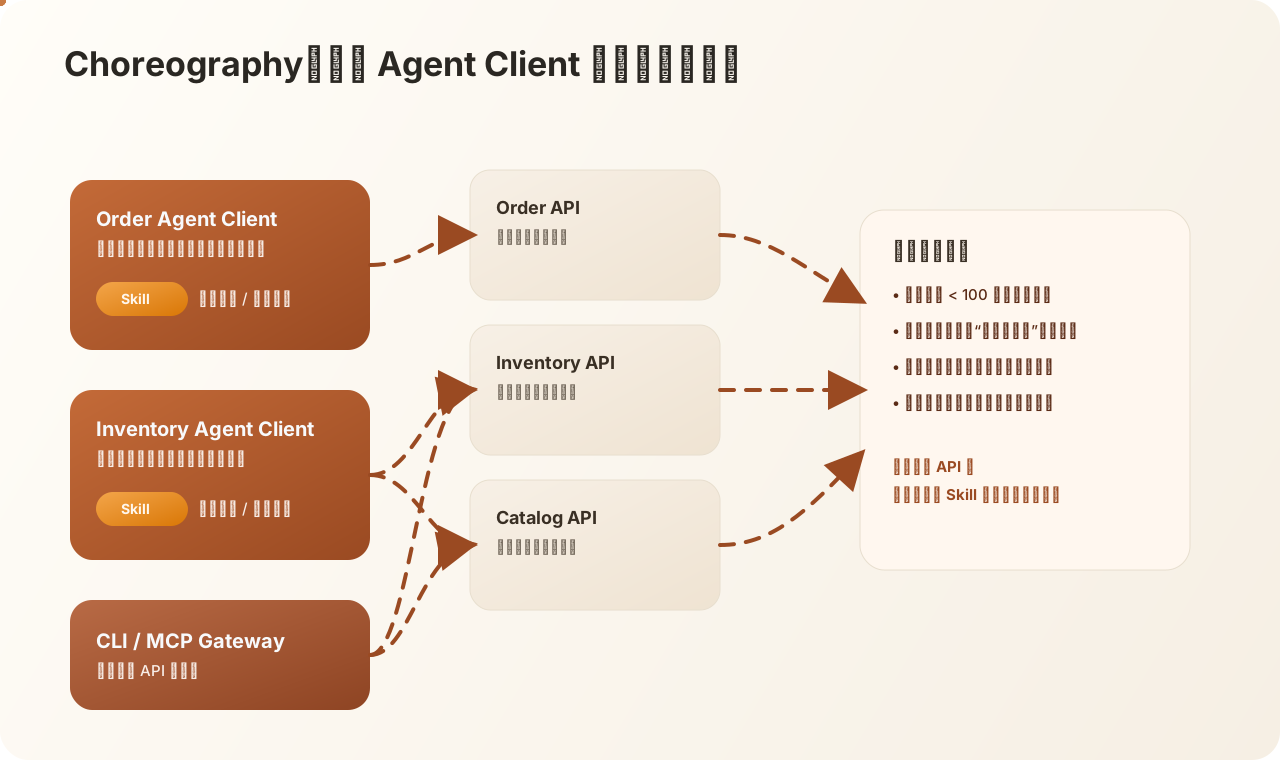
If the Provider keeps OpenAPI unchanged, Agent + Skill may take over part of the client-side integration logic and make service-to-service calls more semantic.
A rewrite retrospective showing how SPDD, TDD, ADRs, and project-level governance compressed what used to take months into roughly one week.

Use Multica to split and drive tasks, then use Brains to distill reusable knowledge and turn an agent workflow into a replayable, accumulative closed loop.
Evaluate old notes across five dimensions and route them into A/B/C migration pipelines with thresholds, CSV fields, and calibration steps for execution.
Evolving a personal knowledge base from note storage to a layered Brains architecture, covering input, knowledge, output layers and agent edit boundaries.
Outlines a layered platform engineering evolution from standardization to API‑driven self‑service, emphasizing thin slices that validate end‑to‑end delivery.
DomainSpec uses transferable specification artifacts to carry business context from discussion through implementation and verification, reducing semantic drift.

Recap of integrating AI into a Mesh-Shaped PKM, shifting focus from note-taking to task-driven workflows and feedback loops that boost execution.